
DWCF State Release Path
Denver Women's Correctional Facility is operated by CDOC. It is not a Denver Sheriff jail, and it should not be described as a county release list. If a Denver County case resulted in a state-prison sentence, the person may have moved from the Denver Sheriff system to DWCF or another CDOC facility. After that transfer, Denver's inmate search no longer answers the state release question.
A release from DWCF may mean parole, discharge, transfer to another CDOC assignment, return to custody on a parole violation, or another state-supervised status. A person can be physically out of prison and still on mandatory parole. That is why the CDOC fields matter: current facility assignment, parole office or region, estimated parole eligibility, next parole hearing, estimated mandatory release, and estimated sentence discharge.
Release destination: DWCF release points to CDOC parole, discharge, another CDOC facility, or another lawful custody/supervision status, not to a Denver jail release feed.
Confirm DWCF Release
For DWCF, the lookup route starts with CDOC Offender Search. A DOC number is the most precise search key. A name search should be narrowed by first name, last name, gender, age, county or case information, and known conviction details. If the person is still assigned to DWCF or another CDOC facility, that is not a release from state custody.
- Open CDOC Offender Search.
- Search by DOC number, or by name and gender if the DOC number is unknown.
- Confirm the match using county, case number, convictions, age, and facility assignment.
- Read parole, mandatory release, and sentence-discharge fields as estimates unless CDOC records confirms them.
- Use CDOC Time & Release or open records when an official release calculation is needed.
The CDOC Offender Search image from the manifest is the fitting source for DWCF because it is the statewide system used to verify state-prison release status.
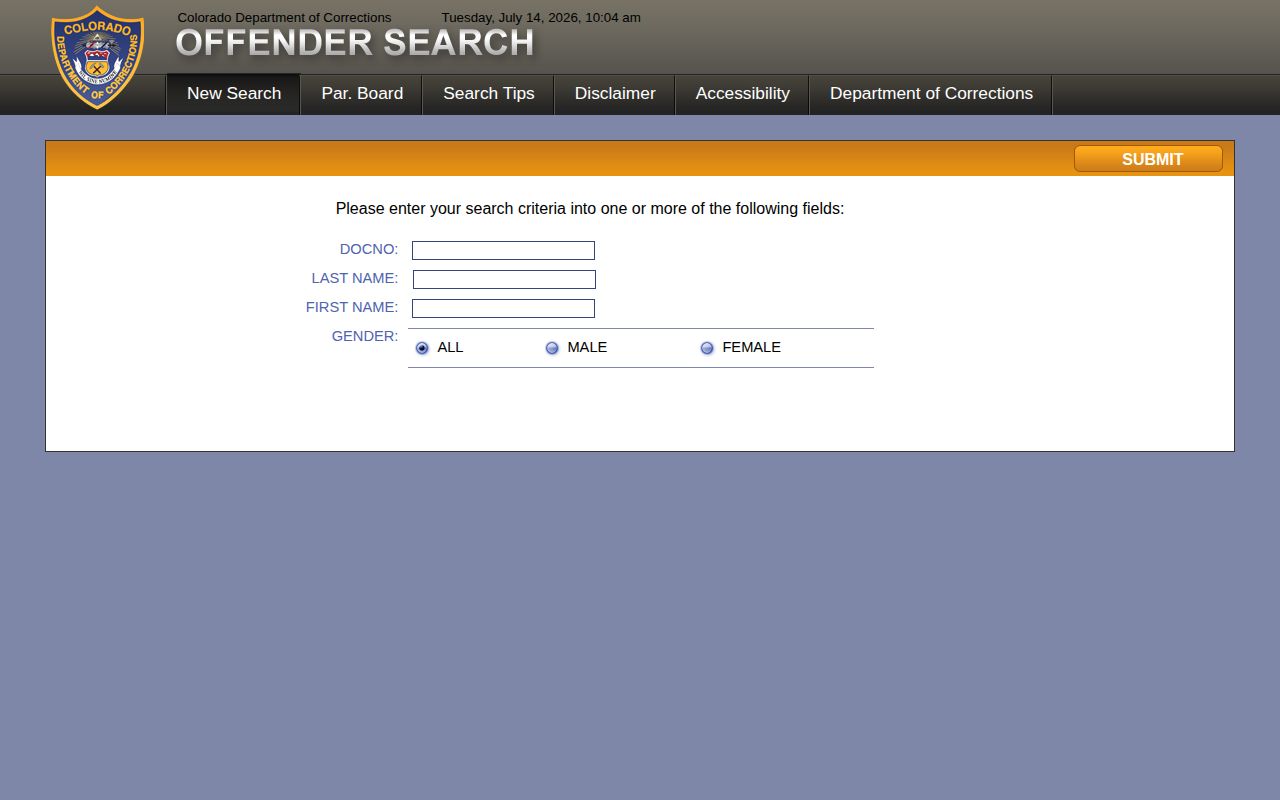
The screenshot supports the central distinction: DWCF records are state correctional records, even when the original case was filed in Denver County.
DWCF Records Contact
The research did not provide a separate DWCF public release-record phone or address. Use CDOC's statewide records route for state-prison release, parole, and discharge questions. If the question is how the person left Denver jail before entering CDOC, use Denver Sheriff or court records for that local transfer event.
Denver Women's Correctional Facility
Denver, CO
Operator: Colorado Department of Corrections
Facility type: state prison / women's classification and custody
CDOC release-record route
CDOC Offender Search
Time & Release / open records: doc_open_records@state.co.us
A focused CDOC request should include name, DOC number, date of birth if known, Denver County case number if known, and the exact status or date requested. Ask for parole release date, mandatory release date, sentence discharge date, current facility assignment, or parole office rather than a vague full-file search.
DWCF Release Records Route
State-prison release records and Denver jail records answer different questions. Denver Sheriff can document the local jail release or transfer to CDOC. CDOC documents the state custody path after commitment, including later parole or discharge. Court records may also explain the sentence that caused the transfer.
CDOC release dates are individualized. Presentence confinement credit, sentence structure, earned time, parole-board action, revocation, detainers, court corrections, and newer statutory rules can change a public estimate. Use the release-date lookup page for the broader Colorado date framework.
For a Denver County case, the court case number and county field can help distinguish one CDOC record from another. A name-only search may be too broad, especially when common names produce multiple results. If the Denver jail record ended at transfer, keep that local release date separate from the later prison release date.
When the CDOC record shows parole, the person may be living outside prison while still serving the sentence under state supervision. When it shows discharge, the sentence may have ended. Those labels should be read with the current facility or supervision assignment, not as stand-alone proof.
DWCF Parole Date Checks
DWCF release research often turns on the difference between parole eligibility, mandatory release, and sentence discharge. Parole eligibility is the first point at which the person may be considered for release by the board. Mandatory release is a projected prison-release date under the sentence and credit structure. Sentence discharge is the end of the sentence, which can be later than the prison-release date when parole applies.
The CDOC Par. Board tab can show scheduled hearings, but a hearing date is not the same as a release date. A hearing may lead to release, deferral, denial, rescission, or another outcome. For a final answer, read the individual CDOC record and verify official calculations through CDOC records when the date matters.
Colorado's release-date rules also depend on the law that applies to the sentence. Earned time, older good-time rules, violent-offense provisions, and court corrections can shift an estimate. Proposition 128 changed parole eligibility for certain covered crimes of violence committed on or after January 1, 2025. That kind of rule is why DWCF pages should say estimated when describing public CDOC dates unless an official CDOC record confirms the calculation.
Match DWCF To Denver Case
A Denver County case can appear in several places before and after DWCF. Denver Sheriff records show the local jail booking and transfer out. Denver County Court or Denver District Court records show the disposition and sentence. CDOC shows the state-prison custody record after commitment. The strongest match uses more than a name: DOC number, county, case number, conviction, age, and known sentence date.
If a family member only knows that Denver's jail search no longer shows the person, do not assume DWCF release. The person may have been transferred into CDOC and classified at DWCF, moved to another prison, paroled, discharged, or returned on a violation. Each path has a different public record.
DWCF Detainer Checks
Federal and immigration questions remain separate from DWCF release. ICE describes detainers as requests lodged after other custody, not as a CDOC sentence or discharge. If an ICE transfer is suspected, confirm the CDOC or Denver release record first, then use the ICE Online Detainee Locator.
For federal prison custody, use BOP only when the person was federally sentenced or transferred to federal custody. A DWCF release does not automatically create a BOP record.
DWCF State Release Path
Denver Women's Correctional Facility is a CDOC state-prison facility, so release confirmation belongs to the statewide offender and records process. A Denver County case can reach DWCF after a felony sentence, but once the person is in CDOC custody the Denver jail search is no longer the right release source. CDOC may show current facility assignment, parole region, parole eligibility, next parole hearing, estimated mandatory release, or estimated sentence discharge fields.
Those fields should be read as CDOC status and date fields. A sentence discharge date may come after physical release from prison because mandatory parole can continue in the community. A parole-region assignment can mean the person is no longer housed at DWCF but still remains under CDOC supervision. For a precise time calculation, use CDOC records or Time & Release.
DWCF Denver Record Match
To connect a Denver County jail case to DWCF, start with the court case and the Denver Sheriff transfer record. The court record explains the sentence and county of conviction. The local jail record can show that Denver Sheriff custody ended through transfer. CDOC then supplies the state-prison custody record. These sources should be matched by name, date of birth if available, case number, conviction county, and DOC number.
If the person is released from prison to parole, verify supervision through CDOC and the Colorado State Board of Parole framework. Probation is different and comes from the court. Do not describe a DWCF release as a Denver County Jail release, because the legal custody and records office are state-level.
DWCF Date Check
A DWCF release-date check should compare the CDOC public fields with the court sentence. Parole eligibility, parole hearing, mandatory release, and sentence discharge are not interchangeable. A person may leave DWCF, move to parole, return on a violation, or discharge later. The public search can show the current status, but official time computation belongs with CDOC records or Time & Release.
If a Denver County family is trying to learn whether a person left prison or only moved within CDOC, the current facility assignment and parole-region assignment are the key clues. A Denver jail roster will not answer that state-prison movement.