
ICE Detainee Release Status
ICE custody is federal civil immigration custody. ICE explains immigration detainers as requests lodged after federal, state, or local law enforcement agencies have taken a noncitizen into custody. A detainer asks the local agency to notify ICE before release or maintain custody for a limited time after release eligibility, depending on the detainer and jurisdictional rules. It is not the same as a Denver criminal sentence.
The safest Denver County wording is precise: a Denver jail release and an ICE custody event are separate. A person may leave Denver Sheriff custody and later be checked in ICE's Online Detainee Locator if an immigration transfer is suspected. The Denver release should still be documented through DSD or court records.
Release destination: ICE release or detention is confirmed by ICE, while Denver Sheriff confirms the local jail release or transfer event.
Confirm ICE Detainee Release
Use the ICE locator for immigration custody, not for an ordinary Denver jail release. If the person was recently in a Denver jail, begin with Denver Sheriff and court sources. Then check ICE only if there is reason to think immigration custody followed or replaced local custody.
- Confirm Denver jail status through the Denver inmate search, VINE, Denver court records, or DSD records.
- Use the ICE Online Detainee Locator for immigration custody when a transfer or detainer is suspected.
- Search with the identifiers the ICE locator requests, such as A-number or biographical information where available.
- Do not treat a missing ICE result as proof that the Denver release record is wrong or that no other custody exists.
- Use official ICE contact paths when the locator cannot resolve the person or the information may lag.
The ICE immigration detainers screenshot from the manifest fits this page because the local Denver issue is often whether a detainer is separate from release.
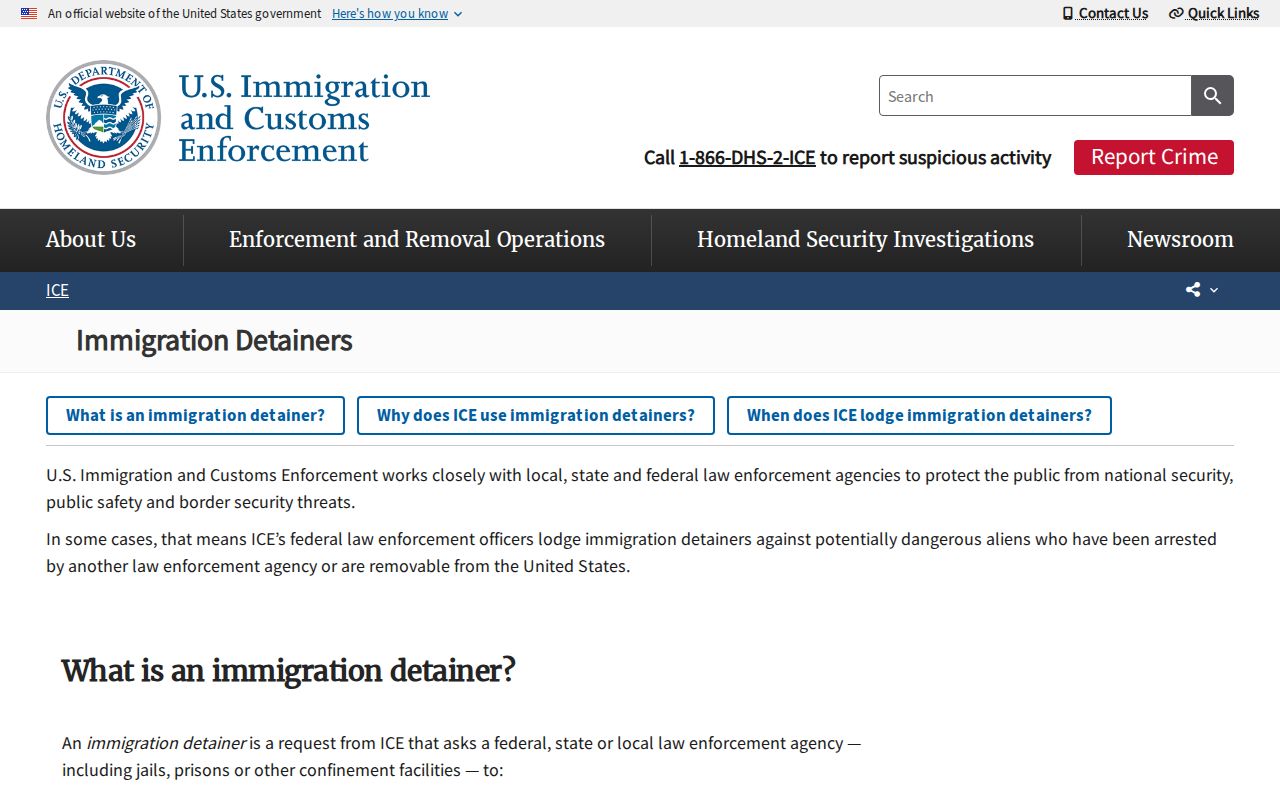
The image supports the central distinction between a Denver release record and a later or separate ICE custody question.
ICE Locator Contact Route
This is not a local jail facility contact page. It is a federal civil immigration locator path. Use Denver Sheriff contacts for the Denver release event and ICE locator/contact paths for immigration custody. Denver's contacts page also references detainer-related material, but the research did not capture enough text to state a broad local rule for every detainer.
ICE Online Detainee Locator
locator.ice.gov/odls
Federal civil immigration custody check
Denver Sheriff local release
Downtown Detention Center: 720-337-0400
Denver County Jail: 720-913-3642
VINE: (888) 263-8463
If requesting Denver records, ask for the release date, release type, and any release-to-agency or transfer notation. If the question is ICE custody after Denver release, use ICE rather than asking Denver Sheriff to confirm a federal civil custody status it does not control.
ICE Release Records Route
Denver Sheriff records can show a local release, transfer, or release-to-agency event. ICE records or locator results address immigration custody. Court records may explain the criminal case, bond, dismissal, sentence, or transfer that preceded the custody change. These records may overlap in time, but they are not the same record.
Colorado-specific reporting and advocacy sources noted in the research show that detainer handling can depend on local legal rules. The content should avoid a blanket claim that Denver will or will not hold someone for ICE in every situation. Verify the specific release and the specific federal custody status.
Detainer Is Not Release
A detainer is a request tied to custody status. It is not a final court disposition, a Denver jail sentence, or proof that ICE physically received the person. That is why the Denver release record and ICE locator result should be checked separately. One may exist while the other is delayed, limited, or not applicable.
If Denver Sheriff records show a release to another agency, ask which agency received custody and then follow that agency's official path. If the record shows a local release without an immigration transfer, do not turn the ICE locator into a general Denver release search.
ICE Locator Limits
The ICE locator is designed for immigration custody checks, and it may require exact identifiers or biographical information. A missing result can mean the person is not in ICE custody, the search data does not match, the record is not publicly shown, or another custody system applies. It should be cross-checked with Denver Sheriff and court records when the person was first held locally.
When the Denver case involved CDOC, BOP, or another county instead of ICE, use those systems. The strongest release confirmation comes from matching the local Denver release record to the next agency named in the record.
Verify Denver Release First
Denver release confirmation starts with the agency that held the person locally. Search Denver's current-custody tool, check VINE for a custody-status change, review the Denver County Court or Denver District Court record, and request DSD records if the release date or destination must be documented. Only then does an ICE lookup answer the separate immigration custody question.
This order matters because the same day can include several events. A court may order release, Denver Sheriff may process the person out of local custody, and another agency may receive or seek custody. Each agency records its own action. A single missing search result should not be used to erase the other records.
ICE Related Records To Request
For Denver records, ask for release date, release time, release type, transfer destination, and any release-to-agency notation. For the court, search the case history for bond, dismissal, sentence, warrant, or transfer information. For ICE, use the locator or official ICE contact route to confirm current immigration custody or release from that custody.
A records request should stay narrow. Asking the right office for the right field is more effective than asking every agency for a full history. Denver Sheriff cannot certify an ICE release, and ICE cannot certify the full Denver court disposition.
ICE Versus BOP Release
ICE and BOP are both federal, but they answer different questions. BOP covers federal criminal custody and federal inmates from 1982 to present. ICE covers civil immigration custody. A person released from Denver jail may have neither, one, or a sequence that involves more than one agency.
When the record says federal custody but does not specify immigration custody, check the context. A federal criminal case, U.S. Marshals transfer, or BOP sentence should not be treated as an ICE detainee record. An immigration detainer should not be treated as a BOP sentence.
Denver Detainer Documentation
If a Denver record mentions an immigration detainer, request the Denver Sheriff release or transfer notation and compare it with any ICE locator result. The Denver record can document the local event, while ICE can address whether a person is in immigration custody. The court record can show the criminal case outcome that led to release eligibility or transfer timing.
Because the research did not capture a full Denver detainer policy text, the page should not promise one universal result. The safer and more accurate path is to verify the specific Denver release, then verify ICE custody or release through ICE. This keeps local criminal custody, civil immigration custody, and court disposition in their proper lanes.
When ICE Does Not Apply
Do not use ICE as a general released-inmate search. If the person was released on bond, sentenced to probation, transferred to CDOC, or moved to federal criminal custody, another system is primary. ICE matters when an immigration custody event or detainer is actually part of the facts. Otherwise, Denver Sheriff records, VINE, courts, CDOC, or BOP will give the better answer.
A missing ICE locator result should be read carefully. It may mean no ICE custody, a data mismatch, a non-public record, or a different agency path. Match the ICE question to the Denver release record before drawing conclusions.
ICE Source Match
An ICE search is strongest when it uses the identifiers requested by the locator and when the Denver record points toward immigration custody. If the Denver court or jail record instead points to bond, probation, CDOC, BOP, or another county, use that route first. A release event can be real even when the ICE locator is not the system that holds the answer.
ICE Record Gap
ICE locator data can lag or fail to match if identifiers are incomplete. Keep the Denver release record, court case, and VINE status together while checking ICE. That combined record trail helps separate an actual immigration custody event from a local release, court order, or transfer to a different non-ICE agency.