
Denver County Projected vs Actual
A projected release date is an estimate or calculated date. An actual release date is the event date when the person leaves a custody setting, transfers, starts parole, or reaches another legally defined status. In Denver County jail custody, the public inmate search is not built as a projected-date calculator. The person may be released on bond, by court order, after time served, to probation, to CDOC, to another county, or to another authority.
For a CDOC sentence, the state record may show estimated parole eligibility, next parole hearing, estimated mandatory release, and estimated sentence discharge. These fields serve different roles. A parole eligibility date opens a possible review point. A mandatory release date is tied to the sentence and time-credit structure. A sentence discharge date can be later than physical prison release because supervision can continue in the community.
That distinction matters for Denver County because a local jail release can be a transfer to CDOC rather than a release to the community. Once the person is in state custody, Denver Sheriff records no longer calculate the prison date. CDOC time computation and parole-board action become the main release-date sources, while Denver court records still explain the conviction, sentence, and any later order that changes the calculation.
Find Denver County Release Dates
The first step is to identify the custody system. A Denver jail booking, a CDOC prison sentence, a federal sentence, and a probation case use different date sources. If the person was only in Denver Sheriff custody, start with the current jail search and court record. If the person was sentenced to state prison, use CDOC Offender Search. If the person is federal, use BOP. If a VINE alert is needed, register on the person record after the correct agency is found.
- Search Denver inmate search by name, booking number, or CD number to see whether the person is still in Denver custody.
- If the person no longer appears, check the Denver County Court public portal or Denver District Court record for bond, disposition, sentence, or transfer details.
- For a state-prison sentence, search CDOC Offender Search by DOC number or name and review the date fields.
- Use the CDOC parole-board schedule when a hearing date, not a final release date, is the question.
- When an official time calculation is needed, use CDOC records or Time & Release rather than a copied public result.
For the broader person-finding route, use the Denver County released inmates search path on the home page. For status alerts, use the VINE inmate check.
If the question concerns a Denver jail sentence rather than a CDOC sentence, the date may not appear in the state offender-search system. Use the mittimus, jail credit, court disposition, and Denver Sheriff records request path. If the person is believed to be in Denver custody but the search does not find them, Denver directs users to call the custody line rather than infer release from a blank result.
CDOC Release Date Fields
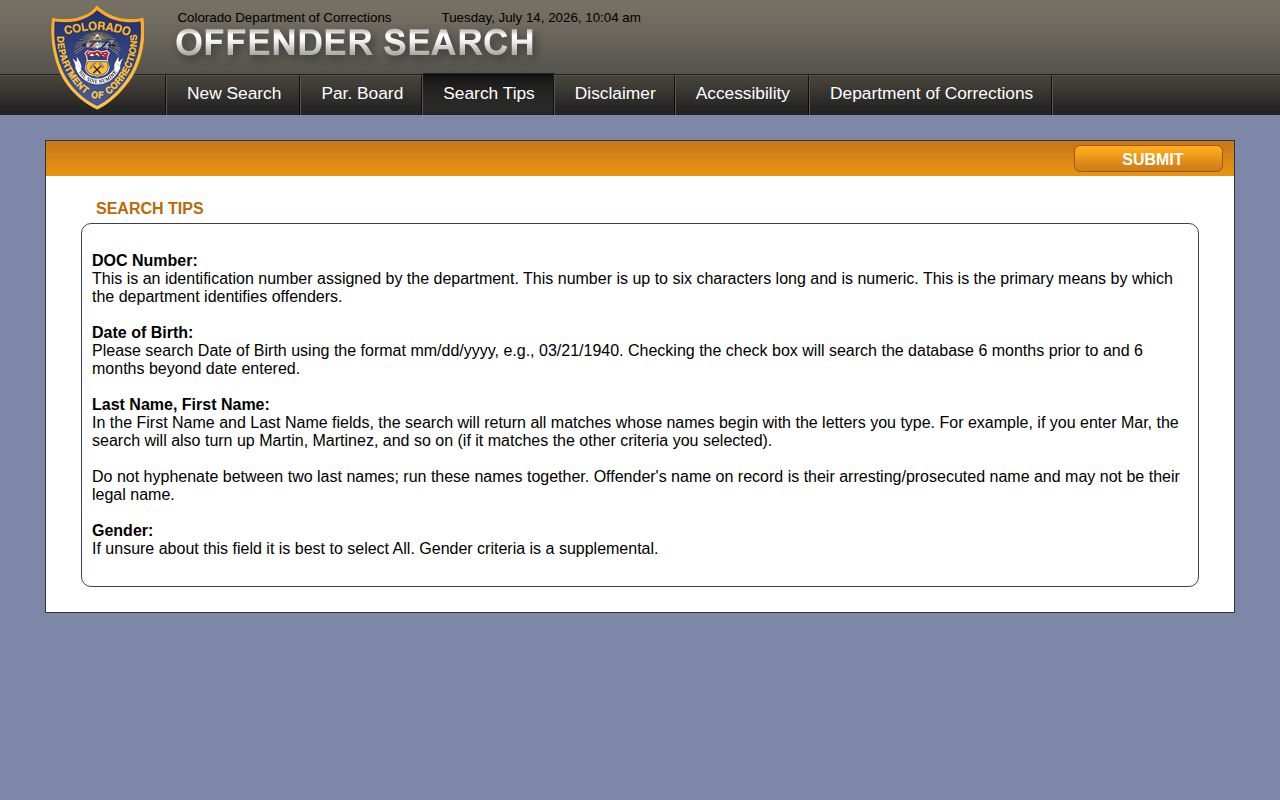
CDOC is the main public date source when a Denver County case became a state-prison sentence. The offender-search form asks for DOCNO, last name, first name, and gender. A DOC number is the cleanest search key. Name searches should be narrowed with other known details because common names can return multiple records.
The screenshot below comes from the CDOC search tips page, one of the state pages used to understand the offender-search fields.
CDOC records should be read as state-prison records. They do not replace Denver Sheriff booking records for a person who was never committed to CDOC.
| CDOC date or field | Release-date meaning |
|---|---|
| Estimated parole eligibility date | The first possible parole-consideration date under the sentence and statute. |
| Next parole hearing date | A board calendar event. It is not the same as actual release. |
| Estimated mandatory release date | A calculated prison-release date that can be affected by credits, holds, rescission, revocation, or sentence changes. |
| Estimated sentence discharge date | The projected end of the sentence, which may fall after release to mandatory parole. |
| Current facility or parole region | Shows whether the person appears to be in prison, assigned to parole, or in another CDOC status. |
Colorado Earned Time Rules
Colorado release-date computation is not one simple formula. C.R.S. 17-22.5-403 is the core parole-eligibility statute, but offense type, sentence date, presentence confinement credit, consecutive or concurrent sentence structure, and special rules can change the result. Older good-time provisions may still matter for older sentences.
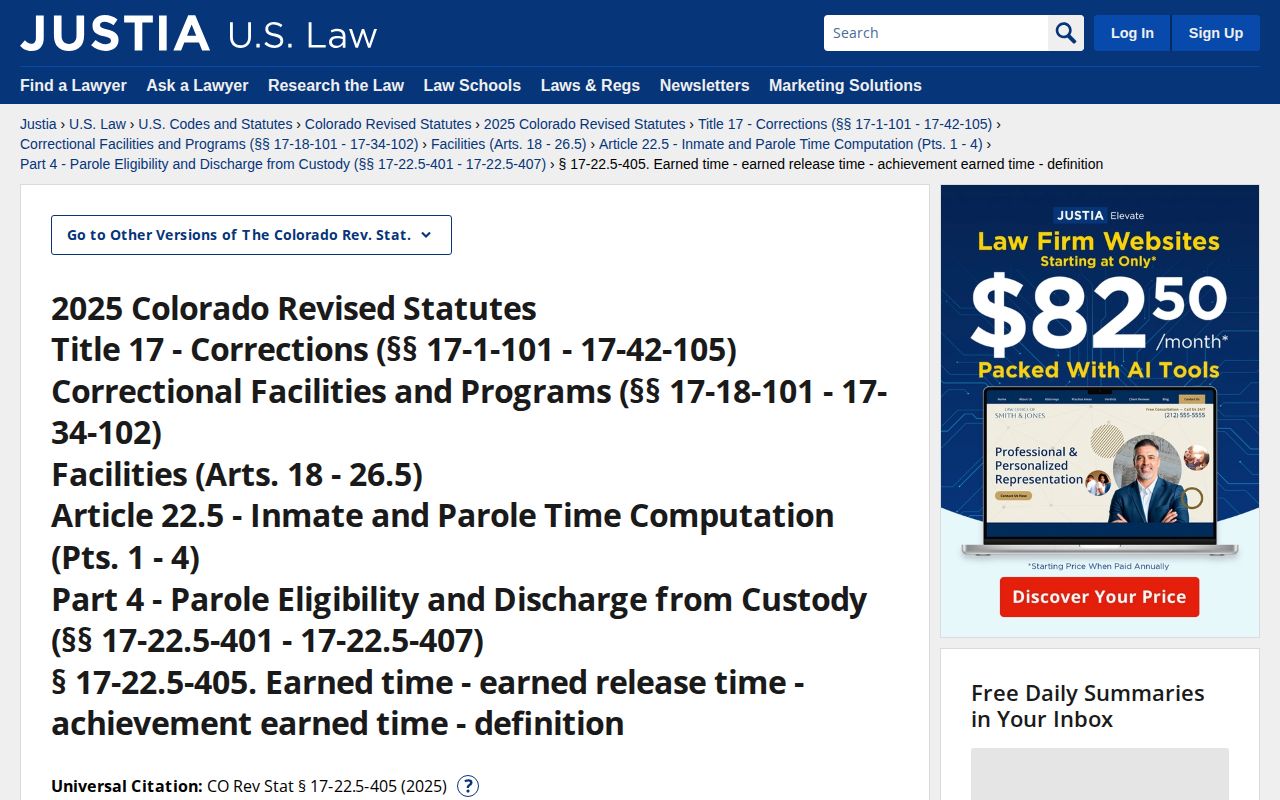
C.R.S. 17-22.5-405 allows earned time for many current sentences, generally not more than ten days per month for demonstrated progress, with up to twelve days per month for certain lower-level felony or drug-felony categories when statutory conditions are met. Credits can be awarded, withheld, or lost. That is why an estimate can move.
The statutory earned-time page is one of the source images for this Denver County release date lookup.
Use the statute for general rules, then rely on CDOC or the court for a person-specific calculation.
CDOC's own search environment has included a notice that official time calculations should be requested through Time & Release or open-records operations. That is the better route when a Denver County release date affects a court filing, travel plan, family pickup, or supervision report date. Public search pages are useful snapshots, but they are not the official calculation worksheet.
Denver County Violent-Offense Dates
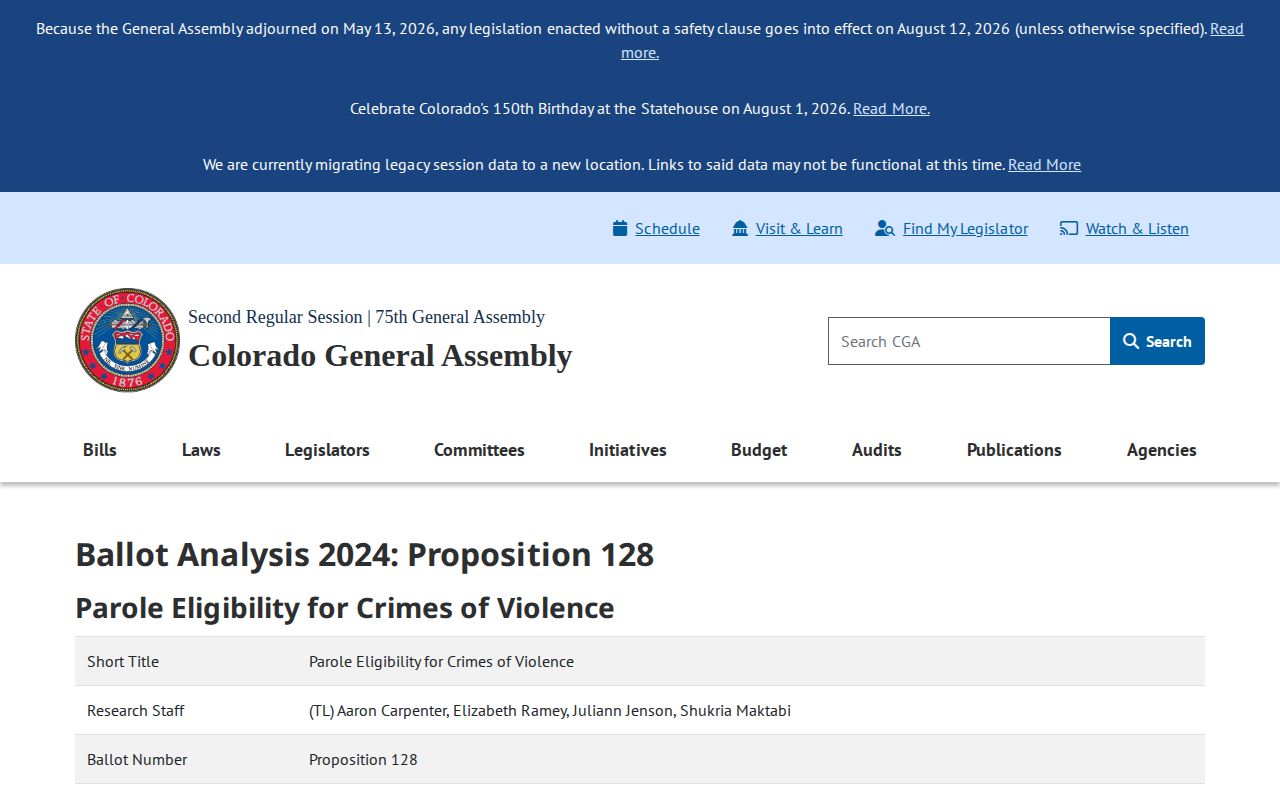
Colorado voters approved Proposition 128 in 2024, and the General Assembly ballot analysis describes a major parole-eligibility change for certain crimes of violence committed on or after January 1, 2025. For covered offenses, the analysis says a person must serve at least 85 percent of the sentence in prison before discretionary parole or earned-time reductions. It also describes stricter treatment for third or subsequent crimes of violence.
Before that change, the official analysis describes a 75 percent threshold for certain covered crimes, minus earned time for program progress. This is why Denver County release date copy should not reduce every Colorado prison sentence to one percentage. The offense date, sentence date, offense category, and number of qualifying convictions matter.
The Proposition 128 ballot analysis is the source for this rule change.
For any specific case, compare the CDOC record with the sentencing court record before relying on a percentage estimate.
Denver County Jail Release Timing
A Denver County jail release date is computed differently from a CDOC prison date. A pretrial person has no set release date unless bond is posted, a court enters a release order, the case is dismissed, or another legal event changes custody. A local jail sentence may depend on the mittimus, jail credit, time served, holds, and any transfer order. A release to probation is confirmed through the court and probation office, not through a CDOC mandatory release field.
Bond releases have their own Denver-specific timing. Denver Sheriff Court Services says bonding inmates are generally released within a two-hour window after the bond is signed by all parties involved, but questions about the bonding process go to Denver County Court's Bonding Office, not the Sheriff Department. Statewide bond law also has timing rules, so the court order and local processing both matter.
Property and paperwork can lag behind the physical exit. Denver materials distinguish property release at the Downtown Detention Center from Denver County Jail property release hours, and unclaimed property may move to the DSD Property Bureau after release. These facts do not change the legal release date, but they often explain why a released person still needs a Denver Sheriff contact after leaving custody.
Denver County Court Bonding Office
Downtown Detention Center lobby
490 East Colfax
Denver, CO
720-337-0062
Verify current bonding hours when release timing depends on a posted bond.
Denver Sheriff Custody Line
Use when Denver says the person should be in custody but the public search does not find them.
720-913-3600
Confirm current custody before treating a missing search result as release.
Why Denver Release Dates Change
A projected date is a snapshot. Denver County and CDOC records can change when a court corrects a sentence, jail credit is recalculated, earned time changes, or another agency files a hold. Parole decisions can also change the path. A grant may be rescinded before release, and a parolee can later be revoked and returned to custody.
| Change factor | Effect on a Denver County release date |
|---|---|
| Presentence confinement credit | Corrected jail credit can move the calculated date forward or backward. |
| Consecutive or concurrent sentences | Sentence structure changes the total time that CDOC or jail must compute. |
| Earned time or discipline | Credits may be awarded, withheld, or lost depending on statutory and institutional rules. |
| Parole-board action | A grant, denial, deferral, tabled decision, rescission, or revocation can change release timing. |
| Detainer, warrant, or new case | Another agency or court may prevent release to the community even when one sentence event ends. |
Note: A transfer from Denver jail to CDOC is a release from local jail custody, but not a release to the community.
Confirm Denver County Release Dates
Use VINE for custody-change alerts, CDOC for state-prison date fields, Denver Sheriff records for the local jail release event, and court records for the order that caused release. When the CDOC date must be official, the research notes a CDOC Time & Release or open-records verification path at doc_open_records@state.co.us. Treat that as a time-calculation verification route, not as a shortcut around sealed or restricted records.
For Denver local jail records, the Sheriff Department's public-records request path is the fallback when online systems do not show the release date, release type, or transfer destination. For court-driven release, the Denver County Court public portal can show register of actions, schedules, parties, charges, sentences, fines, and costs. Denver District Court uses Colorado Judicial Branch records channels.
Sealing can also affect what is visible. Colorado Judicial Branch materials explain that sealed conviction records are not physically destroyed, but public responses can treat them as unavailable. Denver Sheriff records guidance similarly warns that sealed arrest criminal records may receive a "No Such Records Exist" response. A failed public lookup is therefore not always a data error; it can reflect a real access limit.