
Federal BOP Release Status
There is no BOP prison in Denver County in the facility map, but federal releases can involve Denver cases. The BOP Inmate Locator covers federal inmates incarcerated from 1982 to the present. It may show a person as Released or Not in BOP custody with a release date. That means the person is no longer in BOP custody, but it does not prove that no other correctional, court, parole, supervised-release, or law-enforcement status exists.
For Denver County, BOP matters when the person was charged federally, sentenced federally, transferred from Denver jail to federal custody, or held on a federal matter. A Denver jail record may show release to another authority before BOP has a public record. In that gap, federal court records and the local transfer record may be the best route.
Release destination: Federal release points to BOP release status, federal supervised release, another custody system, or a separate court status, not to Denver Sheriff custody by itself.
Confirm Federal Release
Use BOP only after the federal custody path is plausible. If the person was last known to be in Downtown Detention Center or Denver County Jail, first confirm the Denver release or transfer record. Then move to BOP or federal court if the release was to federal custody or if a federal sentence exists.
- Search the BOP Inmate Locator by register number, DCDC number, FBI number, INS number, or name with filters.
- Read whether the person is assigned to a facility, Released, or Not in BOP custody.
- Check back periodically when BOP warns that release dates may shift due to sentence reviews or recalculations.
- Use federal court records when the person was transferred to U.S. Marshals custody but has not yet appeared in BOP.
- Use Denver Sheriff records for the local release-to-agency notation when the path began in Denver jail.
The BOP Inmate Locator image from the manifest fits this page because it is the official federal lookup for released federal inmates.
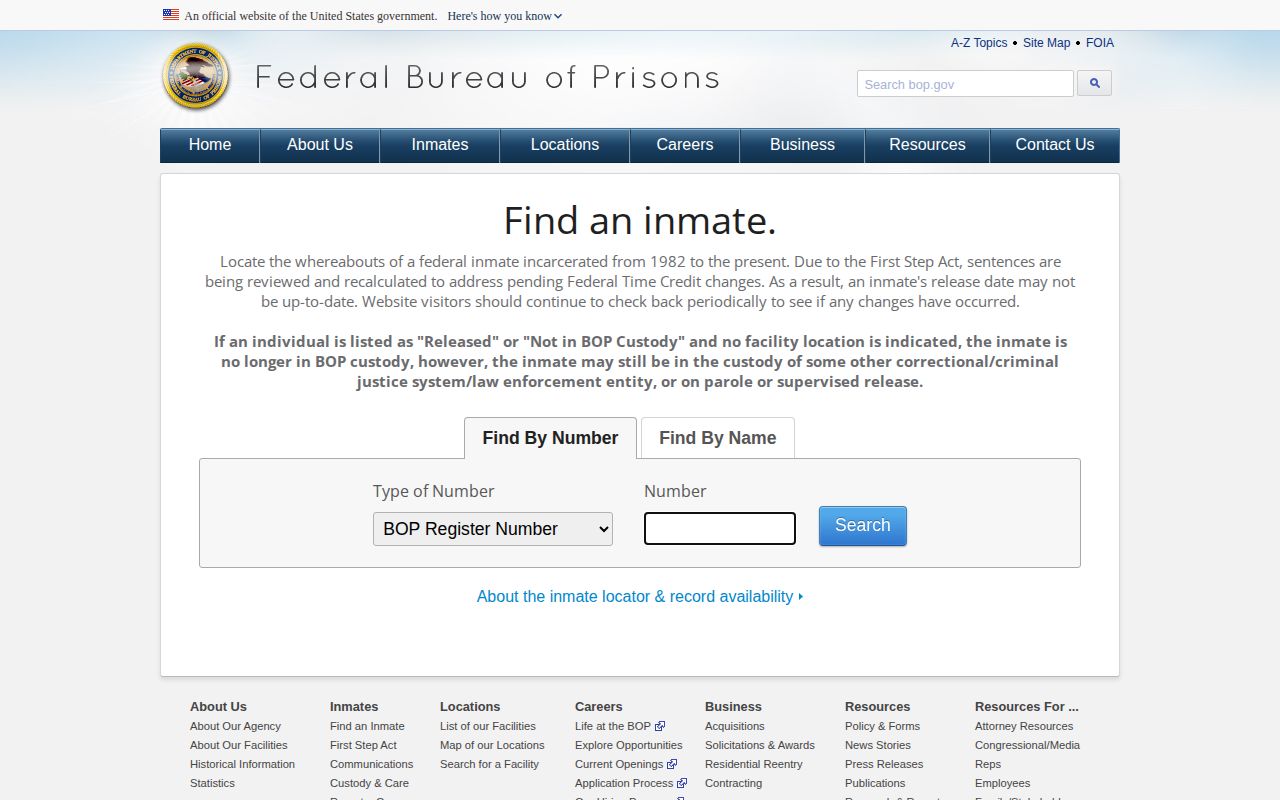
The screenshot supports the key boundary: BOP can confirm a federal custody status, but it does not replace Denver jail, Denver court, or CDOC records.
BOP Release Contact Route
The research did not identify a Denver County BOP facility contact because this page is a federal locator page, not a local prison page. The practical contact route is the BOP locator, federal court records, and Denver Sheriff records when a Denver jail transfer is involved.
Federal Bureau of Prisons
Federal custody locator
BOP Inmate Locator
Records from 1982 to present
Local tie-in
Denver Sheriff records request for local release/transfer
Denver County Court or federal court record for case status
A Denver Sheriff request should ask for the release-to-agency or transfer notation. A BOP search should use the best identifier available, because name-only searches can return multiple people.
Federal Release Records Route
A federal release record is not the same as a Denver jail release record. Denver can document when a person left the local jail. BOP can document federal custody and federal release status. Federal supervised release is separate from Colorado parole and is handled in the federal system.
U.S. Marshals custody is a common source of confusion because public individual lookup is limited. A Denver jail record may say the person was released to USMS, while the person may not appear in BOP until later. In that situation, federal court docket information may be more useful than either jail or BOP alone.
BOP Locator Fields
The BOP locator can be searched with federal identifiers such as a register number, DCDC number, FBI number, or INS number. It can also be searched by name with race, age, and sex filters. Those fields are different from a Denver Sheriff booking number or CDOC DOC number, so a local jail identifier may not be enough for a federal search.
When the result says Released or Not in BOP custody, read it narrowly. It is a BOP custody status. The person may still have federal supervised release, state parole, a local court case, immigration custody, or another agency record. For Denver County cases, the local release-to-agency notation and the federal locator should be read together.
Denver To Federal Transfer
A Denver jail transfer to federal authority can leave a reader with a gap. Denver Sheriff may no longer show the person in local custody, but BOP may not yet show a sentenced federal inmate. That gap does not mean the record disappeared. It means the next source may be federal court, U.S. Marshals process, or BOP after the person enters that system.
If the person was only held locally on a Denver matter, do not use BOP as the main release source. Use Denver Sheriff records, VINE, and court records. BOP becomes relevant only when a federal custody path exists.
Federal Release Date Caution
BOP's own locator materials warn that release dates may not always be current because of First Step Act sentence reviews and recalculations. Treat the displayed date as a federal locator field, not as a Denver County jail release time. If the date is important, check back and compare it with federal court or agency records.
Denver County users also need to separate federal supervised release from Colorado parole. Federal supervised release follows a federal sentence. Colorado parole follows a CDOC state-prison sentence. A person can be out of BOP custody and still have a federal supervision term that is not shown as a Denver Sheriff jail record.
Match BOP To Denver Record
The cleanest match starts with the Denver record if the person was first held locally. Ask Denver Sheriff for the release-to-agency or transfer notation, then compare names, dates, court case details, and federal identifiers. If the Denver record names a federal authority, the BOP locator and federal court become the next step.
If the Denver record does not point to federal custody, BOP should not be used as a catch-all search. A person may instead be in CDOC, another county, ICE custody, probation, parole, or no custody at all.
Federal And ICE Separation
BOP and ICE are different federal systems. A federal criminal sentence belongs in BOP or federal court records. Immigration civil custody belongs with ICE. If a Denver release involved a possible immigration transfer, use the ICE locator, not BOP, unless there is also a federal criminal custody record.
Note: A BOP Released result means no current BOP custody, not proof that every other legal status has ended.
Federal Supervision After Release
A person released from BOP custody may still have federal supervised release. That status is separate from Colorado parole and separate from Denver County probation. BOP's public locator can answer whether the person remains in BOP custody, but it does not give the full supervision record for every federal case. Federal court records and federal probation channels are the better sources for federal supervision terms.
For Denver County readers, this distinction prevents two common mistakes. A federal release date should not be used as a Denver jail release date, and a Denver jail release-to-agency notation should not be treated as a final federal release. Use the local record to document the transfer out of Denver, the federal court record to understand the federal case, and BOP to confirm the federal custody status when BOP custody applies.
When BOP Does Not Apply
BOP should be dropped from the search when the person was held only on a Denver municipal, county, misdemeanor, pretrial, or local jail sentence and no federal custody path appears. In that case, the correct sources are Denver inmate search, VINE, Denver County Court, Denver District Court, Denver Sheriff records, probation, or CDOC if a state sentence exists.
If the person was taken by U.S. Marshals but does not yet appear in BOP, the missing BOP result may reflect timing or status rather than release. Federal court records and the Denver release-to-agency notation can help bridge that gap until BOP records apply.
BOP Source Match
A BOP result should be matched to the Denver facts before it is relied on. Compare the federal identifier, name, age, sex, release date, and known court history. If only a common name matches, use federal court records or the Denver transfer notation to avoid mixing two different people. The BOP locator is strong when the identifiers line up, but it is not a substitute for the local Denver record.
BOP Record Gap
A short gap can exist between Denver release to federal authority and a useful BOP public result. During that gap, the Denver Sheriff transfer notation and federal court docket may carry more value than repeated name searches. Once a BOP record appears, compare its release field with the local transfer date instead of treating the dates as the same event.