
Denver County VINE Coverage
Denver Sheriff directs users to Colorado VINE through the Sheriff contacts page. The page says Colorado VINE is managed by County Sheriffs of Colorado and lets users check custody status through the website, the VINELink mobile app, or a toll-free phone line. Denver also says automated notifications can be requested by phone, email, or text, with TTY available.
Coverage should still be checked person by person. Colorado VINE can cover participating county jail and state systems, but it is not a Denver court portal, not a CDOC time-calculation certificate, and not a federal custody locator. When a Denver jail release may be followed by CDOC custody, probation, parole, or another agency, VINE gives a custody-status signal that must be read with the agency record.
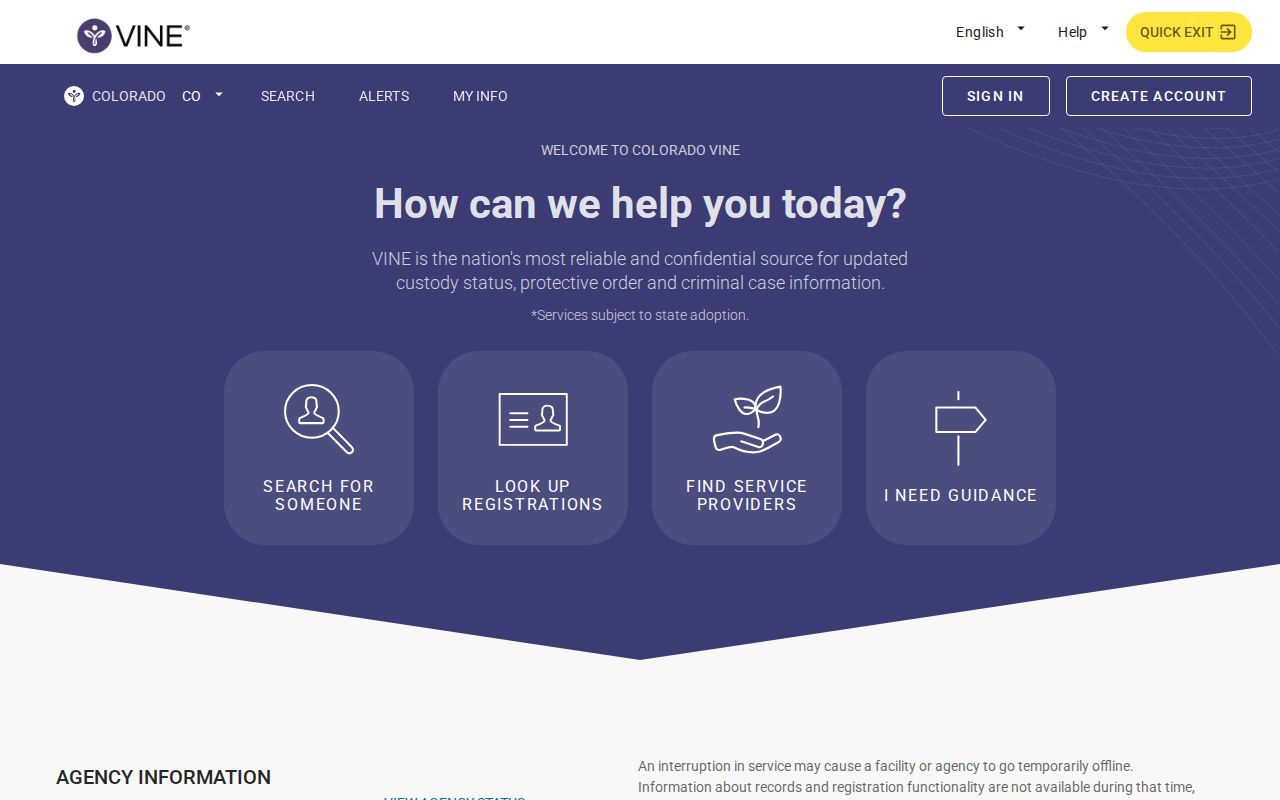
The current Colorado VINE entry point is the Colorado VINELink state page.

The state page is the best starting point because it routes the search through Colorado's current VINE interface rather than an old Denver subject URL.
Search Denver County VINE
A VINE search works best when the person is identified carefully. Denver's inmate app has used a legacy VINE subject-search pattern tied to local offender identifiers, which shows that Denver expects VINE to work as a person-specific custody-notification path. Still, the public search should start from Colorado VINELink and then narrow by name, ID, booking number, or agency if the interface offers those choices.
- Open the Colorado VINELink page and confirm the state is Colorado.
- Search by name first if no ID is known. Add an offender ID, booking number, or agency filter when available.
- Compare likely matches by name, age, booking number, offender ID, and reporting agency.
- Select the matching person record and read the current custody status.
- If the result shows release, transfer, or no current custody with that agency, cross-check the Denver court, Denver Sheriff, or CDOC record before treating the status as final.
Use the general Denver County released inmates workflow on the home page when the goal is to locate the right custody system before opening VINE.
What Denver County VINE Shows
VINE is a custody-status and notification service. For a released Denver County person, the useful result is the status change, not a full court history. The exact field labels can shift as the VINE interface changes and as agencies feed data, so the safer reading is "may show" rather than "always shows."
| VINE field | How to read it for Denver County |
|---|---|
| Custody status | May show in custody, released, transferred, or another custody-change status from the reporting agency. |
| Agency or facility | Helps separate a Denver Sheriff jail record from CDOC or another Colorado agency record. |
| Name and identifier | Use with booking number, offender ID, or other identifiers to avoid mixing people with similar names. |
| Notification options | May allow phone, email, text, or TTY alerts for custody changes where offered. |
| Release or transfer signal | Shows a custody-status change but does not prove a court case is closed or supervision has ended. |
Register Denver County Release Alerts
Denver lists VINE notifications by phone, email, and text, and also notes TTY availability. Registration should be done only on the selected person record. If multiple people have similar names, select the record only after matching the agency and identifier. Phone alerts may require a PIN. That PIN is used to confirm receipt of a notice or stop further phone calls when prompted.
- Open the selected person record in Colorado VINELink.
- Choose the registration or notification option.
- Select phone, email, text, or TTY where the system offers those methods.
- Enter the destination number or address.
- Create or provide the phone PIN when the system asks for one.
- Submit the registration and keep the confirmation details for later changes.
For direct phone access, Denver Sheriff lists Colorado VINE at (888) 263-8463. The VINELink mobile app is a VINE notification app, not a Denver Sheriff recent-release app.
Registration also has a practical limit: it follows the selected record. If the person moves from Denver Sheriff custody to CDOC, another county, federal custody, or a separate civil immigration custody process, a new agency record may need to be checked. Keep the booking number, offender ID, or court case number from the original Denver record so a later transfer can be matched without relying only on name spelling.
Denver County VINE Local Layer
Denver's local layer is important because Denver does not publish a dedicated recent-release list found in the research. A person who drops from the Denver inmate search after being in custody may have been released, transferred, or moved to another system. VINE is one of the fastest ways to watch for the custody-status change, but Denver court and Sheriff records still explain why the release happened.
The Denver Sheriff contacts page lists Colorado VINE alongside jail contacts and other custody resources. That placement matters. It treats VINE as an official notification channel tied to custody status. It does not replace the Denver County Court public portal, the Denver inmate search, or CDOC's offender search for state-prison records.
Denver also lists several custody contact paths on official pages. The Downtown Detention Center and Denver County Jail are local Sheriff facilities, while CDOC records cover state-prison custody and parole. A VINE result should be paired with the agency that had legal custody at the time of the status change. That prevents a Denver jail release from being confused with sentence discharge, probation intake, or a later transfer.
The legacy VINELink Colorado page is also represented in the manifest.
Use the current state VINE URL first, then fall back to legacy links only when an official Denver record routes there.
Denver County VINE Limits
VINE is not a universal custody search. It does not serve as a BOP federal inmate locator, an ICE detainee locator, a sentence-discharge certificate, or a mugshot source. A released result does not prove that charges were dismissed, that probation or parole ended, or that no other case exists. It means the reporting custody source sent a status change.
It also does not calculate Colorado prison time. CDOC date fields such as parole eligibility, next parole hearing, estimated mandatory release, and estimated sentence discharge require CDOC records or time-calculation review when precision matters. For Denver jail cases, release timing may come from a bond order, a court disposition, time served, or a transfer order instead of a VINE date.
| Question | Better Denver County source |
|---|---|
| Was the person released from Denver jail? | Denver Sheriff records, VINE custody notice, and Denver County Court record. |
| Did a state-prison sentence end? | CDOC Offender Search and CDOC records or Time & Release. |
| Is there a federal release? | BOP Inmate Locator for federal custody. |
| Did the court case close? | Denver County Court, Denver District Court, or Colorado Judicial Branch records. |
Note: A released person can leave a jail roster before all court, supervision, property, or transfer questions are resolved.
Cross-Check Denver VINE Results
A Denver County VINE result should be cross-checked because the same person can move through more than one record system. A person booked at the Downtown Detention Center may leave Denver Sheriff custody after bond, a court order, or a transfer. A person sentenced from a Denver felony case may later appear in CDOC records. A person with a separate federal case may not be visible through Colorado VINE at all. Keep the agency name, case number, and booking identifier together when comparing those systems.
Use the Denver inmate search first when the question is current Denver Sheriff custody. Use Denver County Court or Denver District Court when the question is the court order that led to release. Use CDOC when the person was committed to state prison or released to parole. Use VINE for notification of custody-status changes after the correct agency record is found.
Denver's official materials also point people outside Denver when the local search does not match the custody facts. That matters for VINE because a person can be booked in Denver, transferred, and then reported by a different Colorado agency. The agency name on the VINE record should match the known custody path before any release notice is relied on.
| If VINE shows | Next Denver County check |
|---|---|
| Released from a Denver jail agency | Check the Denver court record and request Denver Sheriff records if the release date or release type must be documented. |
| Transferred or no longer in that agency's custody | Search CDOC, BOP, ICE, or the receiving agency if the transfer path is not clear from the court record. |
| Still in custody | Use the Denver inmate search or CDOC offender record for location, booking identifiers, facility, and court or parole date context. |
This cross-check is especially important in Denver because the public jail lookup is current-custody focused and no official Denver 24-hour or 72-hour release feed was found in the research. VINE can fill part of that gap for one person, but it should not be treated as a public release archive. The safer pattern is one person, one agency, one status check, then a records confirmation.
A careful Denver County VINE check keeps the terms separate. "Released" means the reporting agency no longer has that custody status. "Transferred" means another agency may now control the person. "No record" can mean a spelling issue, nonparticipating agency, sealed or restricted data, federal custody, or a person who was never booked under the searched identifier. Each result points to a next check rather than ending the release inquiry by itself.